Introduction
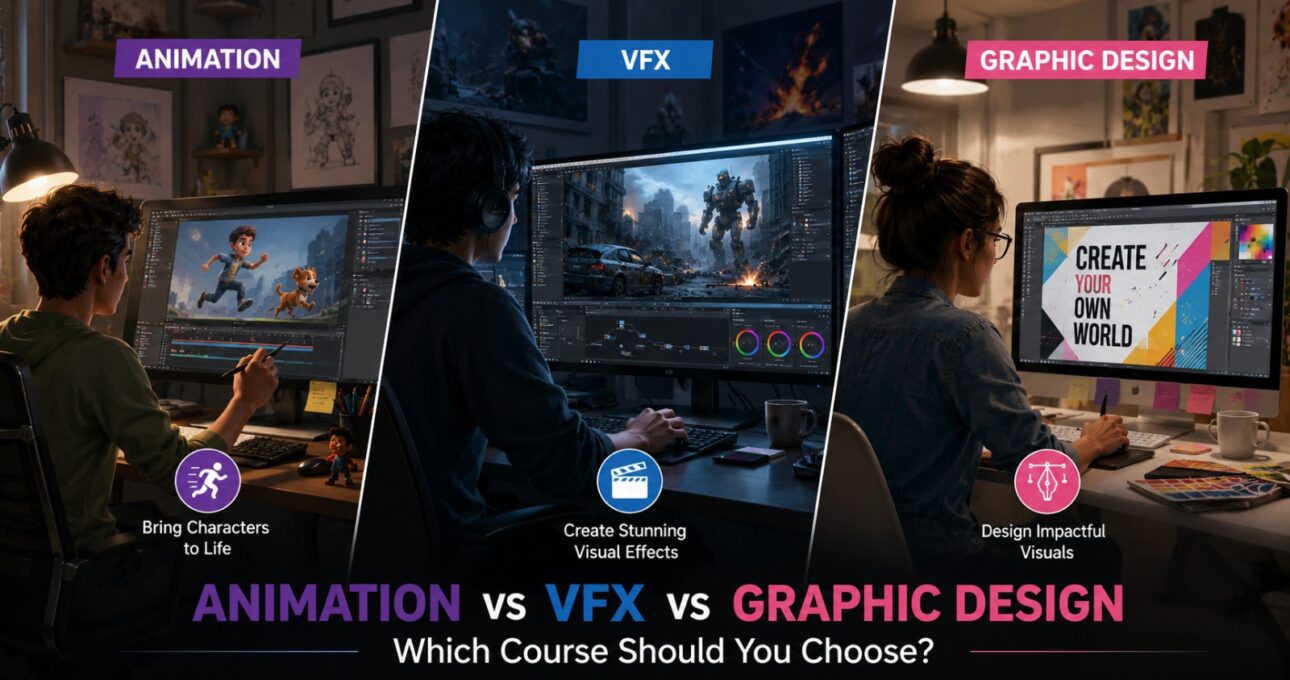
The creative industry is growing fast, and there are many career options for students who enjoy art, design, technology, and storytelling. Among the most popular choices are animation, VFX, and graphic design. But with so many options, one question often comes up: Which course should you choose?
If you are planning a creative career, choosing the right course is important. An animation course in Bangalore can help you learn how to create characters, stories, and moving visuals. A VFX course can teach you how to create realistic effects for films and videos. A graphic design course focuses on creating attractive designs for brands, websites, social media, and marketing.
Each field has different skills, tools, and career opportunities. This guide will help you understand the differences between animation, VFX, and graphic design so you can choose a course based on your interests and career goals.
What Is Animation?
Animation is the process of creating moving images and bringing characters, objects, or stories to life. It is used in movies, TV shows, games, advertisements, educational videos, and online content.
An animation course usually covers areas such as 2D animation, 3D animation, character design, modelling, texturing, rigging, lighting, and storytelling.
Who Should Choose Animation?
Animation may be a good choice if you:
Enjoy drawing and creating characters.
Like storytelling and movies
Want to work on animated films or games.
Enjoy creating movement and expressions.
Are interested in 2D or 3D design
Like learning creative software
A good animation course in Bangalore can give students practical knowledge and help them build a portfolio for creative jobs.
What Is VFX?
VFX, or Visual Effects, is used to create or improve visuals that may be difficult, expensive, or impossible to shoot in real life. It is widely used in movies, web series, advertisements, music videos, and gaming content.
For example, explosions, fantasy locations, superheroes, creatures, weather effects, and digitally created environments can be made using VFX.
A VFX course in Bangalore program may include topics such as compositing, rotoscoping, motion tracking, green-screen work, colour correction, and 3D effects.
Who Should Choose VFX?
VFX could be a good option if you:
Love movies and visual effects
Enjoy working with video.
Are interested in realistic digital effects
Like solving visual problems
Want to work in film or media production.
Enjoy learning technical creative tools.
VFX needs both creativity and attention to detail. You may spend time improving small parts of a scene to make the final result look natural.
What Is Graphic Design?
Graphic design is about communicating ideas through visuals. Designers use images, colours, fonts, shapes, and layouts to create content that is clear and attractive.
Graphic design is used almost everywhere. Businesses need designs for logos, brochures, websites, social media posts, advertisements, packaging, presentations, and more.
A graphic design course can teach you design basics along with tools such as Adobe Photoshop, Illustrator, and other creative software.
Who Should Choose Graphic Design?
Graphic design may be suitable if you:
Enjoy creating posters and social media designs.
Have an interest in colours and typography.
Like branding and advertising
Want to work with businesses and marketing teams.
Prefer shorter creative projects.
Want opportunities for freelance work.
Graphic design can also be a good starting point for students who want to enter the creative industry without focusing heavily on animation or filmmaking.
Animation vs VFX vs Graphic Design: Key Differences
Although all three fields are creative, their work and career paths are different. Understanding these differences can make your decision easier.
Feature | Animation | VFX | Graphic Design |
Main Focus | Creating movement and stories | Creating visual effects | Creating visual communication |
Common Industries | Films, games, TV, ads | Films, OTT, ads, media | Marketing, branding, advertising |
Main Skills | Character design, modelling, animation | Compositing, tracking, effects | Layout, typography, branding |
Creativity Level | Very high | High | Very high |
Technical Skills | Moderate to high | High | Moderate |
Common Tools | Maya, Blender, Adobe tools | After Effects, Nuke, Maya | Photoshop, Illustrator, InDesign |
Career Roles | Animator, 3D Artist, Character Artist | VFX Artist, Compositor, Rotoscopy Artist | Graphic Designer, Brand Designer, Visual Designer |
Freelance Scope | Good | Moderate to good | Very good |
Animation vs VFX: Which One Is Better?
Animation and VFX are closely connected, but they are not the same.
Animation focuses on creating movement. For example, an animator may create the movements and expressions of a 3D character.
VFX focuses more on combining real footage with digital elements or creating effects that make a scene look realistic. A VFX artist may add fire, smoke, a digital background, or other effects to a filmed scene.
If you enjoy characters, storytelling, and creating complete digital scenes, animation may suit you better. If you are more interested in movies, effects, and making impossible scenes look real, VFX may be the better choice.
Animation vs Graphic Design: Which Should You Pick?
The biggest difference is that animation deals with movement, while graphic design mainly focuses on static visual communication.
If you enjoy creating posters, logos, social media content, brand designs, and advertisements, graphic design may be a better option.
If you want to create characters, animated stories, 3D scenes, or game assets, an animation course in Bangalore could be a better fit.
Your career goal should guide your decision rather than simply choosing the course that is popular.
Yes. You do not need to be an expert artist to start learning graphic design. However, you need creativity, patience, and regular practice.
Start with basic design principles. Learn your software step by step. Create small projects and slowly move toward more complex work.
You can also study designs created by professional brands to understand layouts, colors, typography, and visual hierarchy. With consistent practice, your skills can improve significantly.
Is a Multimedia Course a Good Option?
If you are interested in more than one creative field, a multimedia course can be worth considering. Multimedia programs may introduce students to different areas such as graphic design, animation, video editing, web design, and visual communication.
This can be useful for beginners who are still exploring their interests. After learning the basics, you can decide which area you want to specialise in.
However, if you already know that you want to become an animator, VFX artist, or graphic designer, choosing a specialised course may help you develop greater skills in that field.
How to Choose the Right Course
Before selecting a course, ask yourself a few simple questions.
1. What Do You Enjoy?
Think about the type of creative work you enjoy most. Do you like drawing characters? Choose animation. Do you love movie effects? Consider VFX. Do you enjoy posters and branding? Graphic design could be the right option.
2. What Career Do You Want?
Your career goal matters. Research the job roles available after each course and understand what the daily work looks like.
3. What Tools Do You Want to Learn?
Check the software taught by the institute. Practical knowledge of industry-relevant tools can help you create a stronger portfolio.
4. Does the Course Include Projects?
A course should not only focus on theory. Look for practical assignments and projects. A strong portfolio can be very useful when applying for internships or jobs.
5. Check the Institute Carefully
Before joining, compare the course duration, syllabus, faculty, projects, lab facilities, and placement support. Also check student reviews and previous student portfolios.
Career Opportunities After These Courses
The creative industry offers different roles based on your skills.
After animation, you can explore roles such as 2D Animator, 3D Animator, Character Designer, 3D Modeller, Rigging Artist, or Game Artist.
After VFX, career options can include VFX Artist, Compositor, Rotoscopy Artist, Matchmove Artist, and Motion Graphics Artist.
After graphic design, you can work as a Graphic Designer, Brand Designer, Visual Designer, UI Designer, Social Media Designer, or freelance designer.
The key is to keep improving your skills and build a strong portfolio.
Conclusion
Animation, VFX, and graphic design are all exciting career options, but the best choice depends on your interests and goals. If you love characters, storytelling, and movement, an animation course in Bangalore may be the right path. If you are passionate about movies and digital effects, VFX could be a better fit. If you enjoy branding, posters, social media, and visual communication, graphic design may suit you.
There is no single course that is best for everyone. Choose the field that matches your creativity, interests, and career plans. With the right training, regular practice, and a strong portfolio, you can build a rewarding career in the creative industry.
FAQs
1. Which is better, animation or graphic design?
Neither is automatically better. Animation is suitable for people interested in characters, storytelling, and motion. Graphic design is better for those who enjoy branding, layouts, posters, and visual communication.
2. Is an animation course in Bangalore good for career growth?
Yes. An animation course in Bangalore can help students develop skills in areas such as 2D animation, 3D animation, modelling, and character design. Career growth depends on your skills, portfolio, experience, and continuous learning.
3. Is VFX difficult to learn?
VFX can take time to learn because it combines creative and technical skills. With regular practice and proper training, beginners can gradually understand tools and techniques used in the industry.
4. Can I get freelance work after a graphic design course?
Yes. Graphic designers can find freelance opportunities in areas such as social media design, branding, advertisements, presentations, thumbnails, and marketing materials. A good portfolio can help attract clients.
5. Should I choose a multimedia course or a specialised course?
If you are unsure about your career direction, a multimedia course can help you explore different creative areas. If you already know your preferred field, a specialised course in animation, VFX, or graphic design may help you develop greater skills.