Introduction
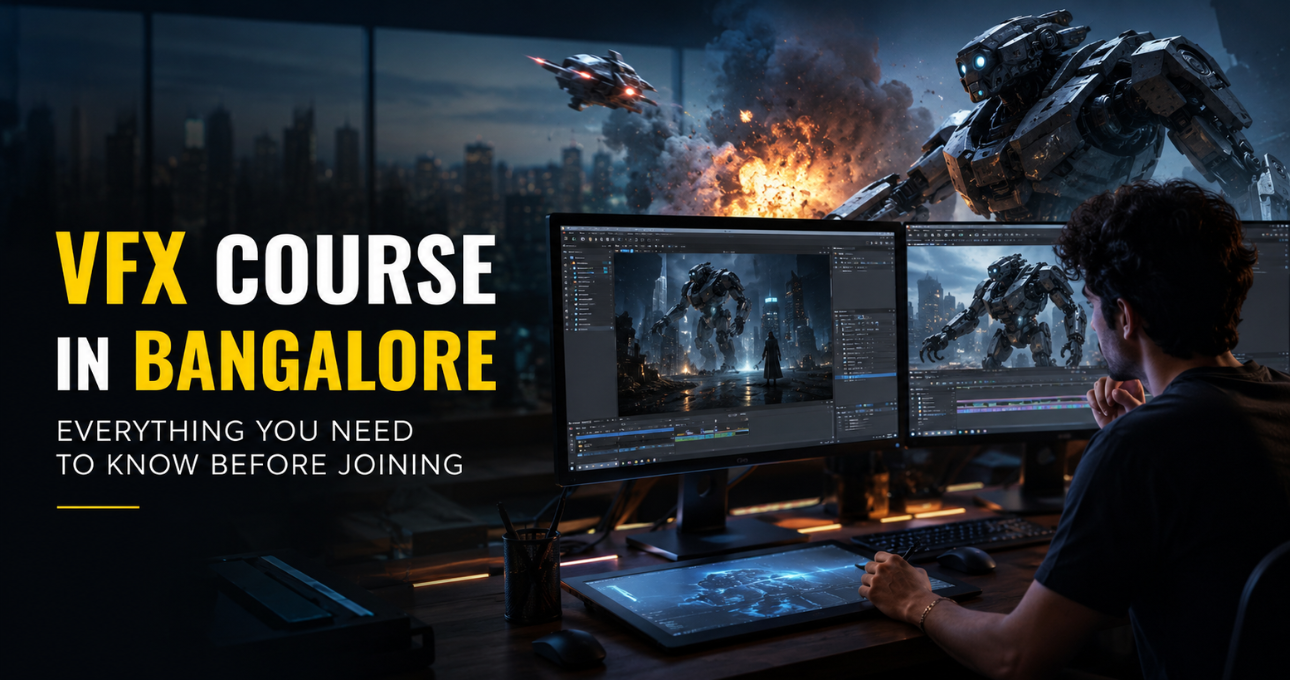
The world of movies, web series, advertisements, games, and digital content is growing fast. Behind many of the amazing scenes we see on screen, there is a team of skilled VFX artists who bring creative ideas to life. If you are interested in animation, movies, design, editing, or visual storytelling, a VFX course in Bangalore can be a great career option.
Bangalore is one of India’s leading cities for technology, media, design, and creative careers. It offers many learning options for students who want to enter the visual effects industry. But before joining a course, it is important to understand what VFX is, what you will learn, how long the course takes, and what career options are available.
This guide will help you understand the important things to consider before choosing a VFX course in Bangalore.
What Is VFX?
VFX stands for Visual Effects. It is the process of creating or changing images and scenes using computer software and other digital tools.
For example, when you see a superhero flying, a city being destroyed, a magical world, or a character standing in a completely different location, VFX may be used to create that scene.
VFX is used in:
- Movies and web series
- Television advertisements
- Music videos
- Gaming
- Short films
- Product videos
- Corporate videos
- Digital content
VFX combines creativity with technology. Students learn how to turn simple footage into attractive and realistic visuals.
Why Choose a VFX Course in Bangalore?
Bangalore is known mainly as a technology hub, but it also has a growing creative and media industry. This makes the city an attractive place for students who want to learn VFX.
A good VFX course in Bangalore can provide practical training along with classroom learning. Students can learn industry software, work on projects, and understand how professional VFX production works.
Another benefit is exposure. Being in a large city can help students attend workshops, interact with professionals, build connections, and explore different job opportunities.
However, students should not choose an institute only because of its location. The quality of training, faculty, software, projects, and placement support should also be checked.
What Will You Learn in a VFX Course?
A professional VFX course usually covers different areas of visual effects. The exact subjects may differ from one institute to another.
- Basics of VFX
Students first learn the basic concepts of visual effects, composition, lighting, colors, camera angles, and visual storytelling.
- Rotoscopy
Rotoscopy involves selecting and separating objects or people from video footage. It is commonly used when an artist needs to change the background or add other visual elements.
- Compositing
Compositing is one of the important parts of VFX. It involves combining different images, videos, and effects to create one final scene.
- 3D Modeling
Students learn how to create 3D objects and characters using digital software. These models can be used in films, advertisements, games, and other media.
- Texturing and Lighting
A 3D model needs proper texture and lighting to look realistic. Students learn how to add surface details and create suitable lighting for a scene.
- Motion Graphics
Motion graphics combine graphic design, animation, text, and visual effects. They are commonly used in advertisements, social media videos, title sequences, and promotional content.
- Green Screen and Chroma Key
Green screen techniques allow filmmakers to replace a background with another image or video. Students learn how to remove the green background and create a natural-looking final scene.
How to Choose the Right VFX Institute in Bangalore
Choosing the right VFX institute in Bangalore is an important decision because the quality of training can have a major impact on your skills.
Before joining, check the following points:
Course syllabus: Make sure the syllabus covers both basic and advanced VFX concepts.
Industry software: Check whether students get practical training on commonly used VFX and 3D software.
Experienced trainers: Trainers with industry experience can help students understand real production work.
Practical projects: VFX is a practical skill. Choose an institute where you have enough opportunities to work on projects.
Portfolio development: A strong portfolio can help you show your skills to potential employers.
Placement support: Check whether the institute provides career guidance, interview preparation, internships, or placement assistance.
Infrastructure: Computer systems and software should be suitable for VFX training because VFX work requires good processing power.
VFX Course Options You Can Consider
Different students may choose different course levels depending on their education, interests, and career plans.
Course Type | Typical Duration | Suitable For | Main Focus |
Certificate Course | 3–6 months | Beginners | VFX basics and software |
Diploma Course | 1–2 years | Students after school/college | Complete VFX training |
Advanced VFX Course | 1–2 years | Serious career seekers | Advanced VFX and production |
Specialized Course | 3–12 months | Existing designers/editors | Specific VFX skills |
Short-Term Workshop | Few weeks | Beginners/professionals | Specific tools or techniques |
The duration and subjects can vary depending on the institute. It is always better to compare the syllabus before making a decision.
What Software Is Used in VFX?
Software knowledge is an important part of VFX training. Depending on the course, students may get training in tools used for compositing, 3D design, editing, animation, and motion graphics.
Some commonly used software includes:
- Adobe After Effects
- Adobe Photoshop
- Autodesk Maya
- Blender
- Nuke
- Premiere Pro
- DaVinci Resolve
You do not need to master every software program at once. A good course should help you learn the right tools step by step.
Skills You Need for a VFX Career
Technical software skills are important, but they are not the only things needed for a successful VFX career.
You should also develop:
- Creativity
- Attention to detail
- Patience
- Problem-solving skills
- Time management
- Basic drawing and design knowledge
- Understanding of colors and lighting
- Teamwork
- Willingness to learn new tools
VFX projects can involve many revisions. So, patience and attention to small details are very important.
Career Opportunities After a VFX Course
After completing a professional course, students can explore several roles in the creative industry.
Some common job roles include:
- VFX Artist
- Compositor
- Rotoscopy Artist
- 3D Modeler
- 3D Animator
- Lighting Artist
- Motion Graphics Artist
- VFX Editor
- Matchmove Artist
- Graphic Designer
The type of job you get will depend on your skills, portfolio, specialization, and experience. Starting with internships or junior-level roles can help you gain practical industry experience.
Is VFX a Good Career Choice?
VFX can be a good career choice for students who enjoy creative work and technology. The industry continues to create content for films, OTT platforms, advertising, gaming, social media, and other digital platforms.
However, joining a course alone does not guarantee a job. Students need to practice regularly and build a strong portfolio. The best way to stand out is to create original projects that show what you can actually do.
It is also important to keep learning because VFX software and production techniques continue to change.
Things to Check Before Joining a VFX Course
Choosing the right VFX course in Bangalore can be the first step toward building a creative career in visual effects. From movies and OTT content to advertisements, gaming, and digital media, VFX skills are useful across many industries.
Before joining, understand the course syllabus, software training, practical projects, faculty experience, infrastructure, and career support. Most importantly, choose a course that gives you enough opportunities to practice and build a strong portfolio.
If you are creative, patient, interested in technology, and ready to keep learning, VFX can open the door to many exciting career opportunities.
Conclusion
Choosing the right VFX course in Bangalore can be the first step toward building a creative career in visual effects. From movies and OTT content to advertisements, gaming, and digital media, VFX skills are useful across many industries.
Before joining, understand the course syllabus, software training, practical projects, faculty experience, infrastructure, and career support. Most importantly, choose a course that gives you enough opportunities to practice and build a strong portfolio.
If you are creative, patient, interested in technology, and ready to keep learning, VFX can open the door to many exciting career opportunities.
FAQs
- Is VFX a good career option after 12th?
Yes. Students who have completed 12th can choose a VFX diploma or certificate course. A strong interest in creativity and digital design can be helpful.
- How long does a VFX course take?
The duration depends on the type of course. Short-term courses can take a few weeks or months, while diploma and advanced programs may take one to two years.
- Do I need drawing skills to learn VFX?
Basic drawing and design skills can be helpful, but you do not need to be an expert artist. You can develop your creative and technical skills through regular practice.
- What jobs can I get after learning VFX?
You can explore roles such as VFX Artist, Compositor, Rotoscopy Artist, 3D Modeler, 3D Animator, Lighting Artist, and Motion Graphics Artist.
- How do I choose the best VFX institute in Bangalore?
Compare the syllabus, faculty, software, practical training, projects, infrastructure, portfolio support, internship opportunities, and placement assistance before choosing an institute.